Home › North Carolina History › Appalachian Music
On June 6, 1928, Bascom Lamar Lunsford held a first mountain music contest in Pack Square in Asheville, the start of today's Mountain Dance and Folk Festival. Doc Watson, born in Watauga County, and Earl Scruggs, born near Shelby, are among the best-known names.
- Jun 6, 1928First mountain folk festival
- 1945Scruggs joins Bill Monroe
- 1988MerleFest founded
- 1997Doc Watson: National Medal of Arts
- Short Version
- At a Glance
- The first mountain folk festival, 1928
- Bluegrass takes shape
- Doc Watson and the folk revival
- Hear it today
- Visit
- FAQ
The Short Version
Old-time and bluegrass music grew in the North Carolina mountains and foothills. Lunsford's Asheville festival, Earl Scruggs's three-finger banjo style and Doc Watson's flatpicked guitar are the best-documented threads, and MerleFest in Wilkesboro and the Earl Scruggs Center in Shelby keep them alive.
At a Glance
| Date | What happened | Source |
|---|---|---|
| June 6, 1928 | Bascom Lamar Lunsford held the first festival, a contest for musicians and dancers, in Pack Square in Asheville alongside the Rhododendron Festival. | ncpedia.org |
| 1930 | The festival separated from the Rhododendron Festival and became the Mountain Dance and Folk Festival. | ncpedia.org |
| March 3, 1923 | Arthel Lane 'Doc' Watson was born in Watauga County; an eye infection left him blind as a baby. | dncr.nc.gov |
| January 6, 1924 | Earl Scruggs was born in the Flint Hill community near Shelby, Cleveland County. | ncpedia.org |
| 1945 | Scruggs joined Bill Monroe's Blue Grass Boys; his three-finger style made the banjo a lead instrument. | ncpedia.org |
| 1948 | Scruggs left Monroe and co-formed the Foggy Mountain Boys with Lester Flatt. | ncpedia.org |
| 1953 | Doc Watson taught himself fiddle parts on guitar for a band that often lacked a fiddler. | dncr.nc.gov |
| 1961 | Watson performed in Greenwich Village, which led to more concerts. | dncr.nc.gov |
| 1963 and 1964 | Watson played the Newport Folk Festival both years. | dncr.nc.gov |
| 1985 | Watson's son Merle died in a tractor accident; the family later founded MerleFest in his honor. Scruggs entered the Country Music Hall of Fame the same year. | ncpedia.org |
| 1988 | MerleFest was founded in memory of Eddy Merle Watson, as a fundraiser for Wilkes Community College in Wilkesboro. | merlefest.org |
| 1997 | Doc Watson received the National Medal of Arts. | dncr.nc.gov |
| March 28, 2012 | Earl Scruggs died in Nashville, Tennessee. | ncpedia.org |
| 2012 | Doc Watson died; he is buried in the Merle and Doc Watson Memorial Cemetery in Deep Gap. | dncr.nc.gov |
The First Mountain Folk Festival, 1928
In 1928 Asheville invited Bascom Lamar Lunsford to bring musicians and dancers to the Rhododendron Festival. The first event was June 6 in Pack Square. By 1930 it stood on its own as the Mountain Dance and Folk Festival. (source)
The festival is where group clogging is said to have started, and it is traditionally held the first weekend of August. It faded in the early 1960s and returned later in the decade. (source)
Bluegrass Takes Shape
Earl Scruggs grew up near Shelby. In 1945 he joined Bill Monroe's band, and his three-finger picking gave the banjo a new voice. In 1948 he and Lester Flatt formed the Foggy Mountain Boys. (source)
After 1945 the bluegrass sound spread through North Carolina. Flatt and Scruggs made Raleigh their home for a time. (source)
Doc Watson and The Folk Revival
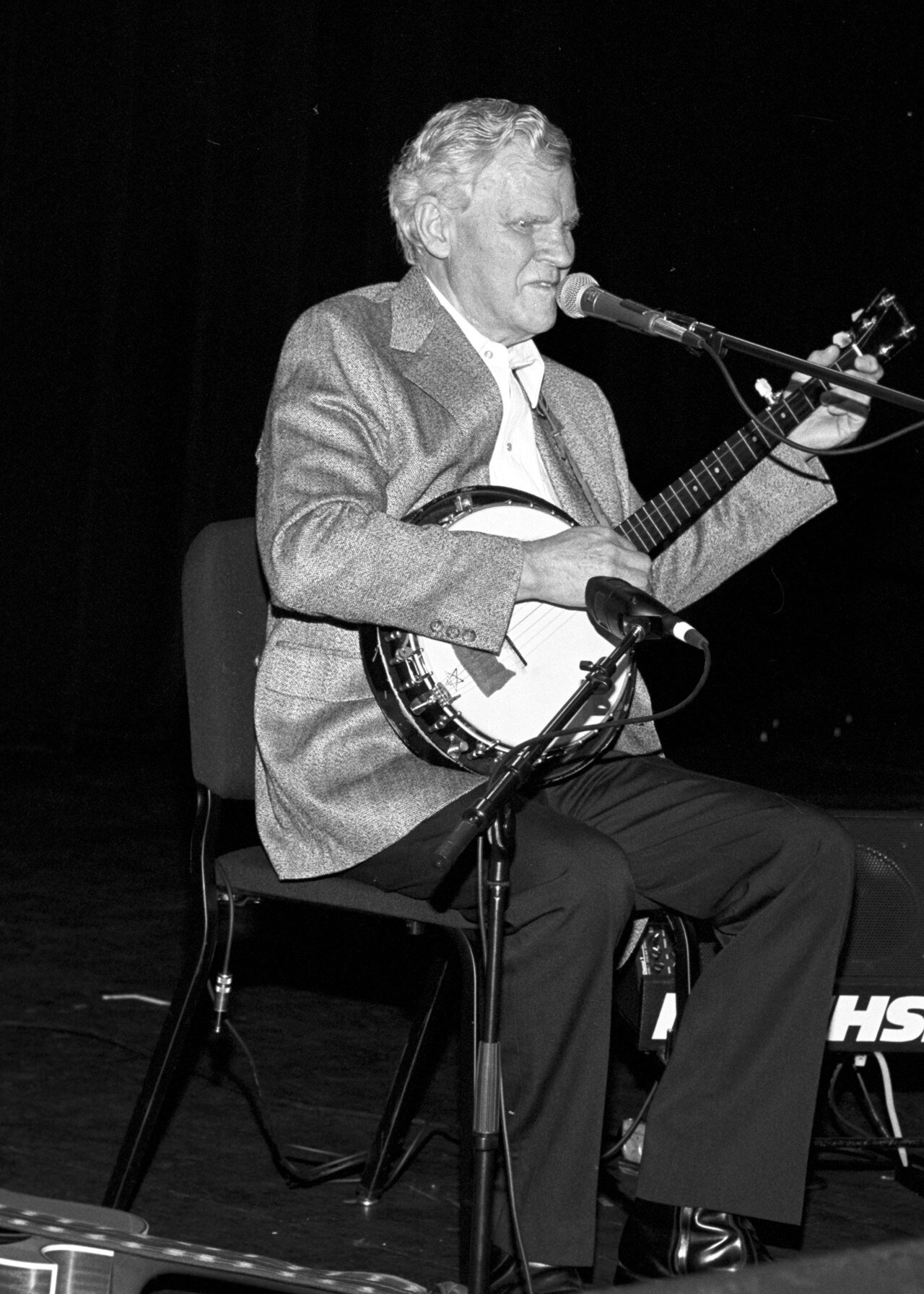
Doc Watson, blind from infancy, went to the Governor Morehead School in Raleigh. He taught himself fiddle tunes on guitar in 1953, played Greenwich Village in 1961, and Newport in 1963 and 1964. (source)
After Merle Watson's death in 1985 the family founded MerleFest. It started in 1988 on the Wilkes Community College campus in Wilkesboro and runs four days each year. (source)
Hear It Today
Blue Ridge Music Trails of North Carolina is a guide to traditional music in the mountains and foothills, with concerts, jam sessions, a map, and a free Down the Road guide covering 29 counties. (source)
At Parkway milepost 213, the National Park Service's Blue Ridge Music Center offers a free museum and free Midday Mountain Music on its breezeway during the season. (source)
Where to Visit
- Earl Scruggs Center, Shelby: Exhibits, programs and live music on Cleveland County and the Scruggs style; 103 S. Lafayette St.
- MerleFest, Wilkesboro: Four-day annual festival on the Wilkes Community College campus.
- Blue Ridge Music Trails of North Carolina: Event map, itineraries and the free Down the Road guide.
- Blue Ridge Music Center, Parkway milepost 213: National Park Service site just across the state line in Virginia; free museum and Midday Mountain Music, May through October; Saturday evening concerts need tickets.
- Mountain Dance and Folk Festival, Asheville: Traditionally the first weekend of August; check the Folk Heritage Committee for current dates.
On this site: Blue Ridge Parkway, Asheville and Foothills Events, High Country Events, Music Events.
Still Unconfirmed
- Sources give Doc Watson's birthplace as Watauga County, Deep Gap or Stoney Fork; only the county is printed.
- Present-day dates and the venue for the Mountain Dance and Folk Festival were not on the pages we read. Check the festival's own site.
- The Blue Ridge Music Center on the Parkway is in Virginia, just over the line, so it is not a North Carolina site. The 2002 date is for Phase 1 of that center only.
Frequently Asked Questions
When was the Mountain Dance and Folk Festival first held?
June 6, 1928, in Pack Square in downtown Asheville, organized by Bascom Lamar Lunsford.
Where was Earl Scruggs from?
He was born January 6, 1924, in the Flint Hill community near Shelby, in Cleveland County. The Earl Scruggs Center is in Shelby.
What is MerleFest?
A four-day annual music festival at Wilkes Community College in Wilkesboro, founded in 1988 in memory of Eddy Merle Watson, son of Doc Watson.
What is Blue Ridge Music Trails of North Carolina?
A guide to traditional music in the state's mountains and foothills, with an event map, itineraries and a free Down the Road guide.
Is the Blue Ridge Music Center in North Carolina?
No. It is at Blue Ridge Parkway milepost 213 near Galax, Virginia, close to the state line. Its museum is open May through October.
More North Carolina History
- History Hub
- Timeline
- Historic Sites
- Legends Trail
- Black History
- Civil War
- Lighthouses
- Revolutionary War
- Textiles and Tobacco
- Wright Brothers and Aviation
Sources
- NCpedia: Mountain Dance and Folk Festival
- NC DNCR blog: Doc Watson, late bloomer
- NCpedia: Earl Scruggs
- NCpedia: Folk Music Part 3
- NCpedia: Bluegrass music
- MerleFest: About
- Blue Ridge Music Trails of NC
- Blue Ridge Music Center
- Earl Scruggs Center
Read on October 27, 2026. Secondary sources are labelled in their titles. How we check: editorial standards; spot a mistake? tell us.
Cite this page: It's North Carolina, “Appalachian Music and Bluegrass in North Carolina”, itsnorthcarolina.com/history/appalachian-music/ (updated ). By the It's North Carolina editorial team. Free to quote with attribution and a link to this page; data and tables are licensed CC BY 4.0.