Home › North Carolina History › Civil War
North Carolina's secession convention met in Raleigh and unanimously passed the ordinance to leave the Union on May 20, 1861. The war here ended with the fall of Fort Fisher on January 15, 1865 and the surrender at Bennett Place on April 26, 1865.
- May 20, 1861Secession convention
- Jan 15, 1865Fort Fisher falls
- Mar 19, 1865Bentonville begins
- Apr 26, 1865Bennett Place surrender
- Short Version
- At a Glance
- 1861: leaving the Union
- 1862: Roanoke Island and the coast
- Winter 1865: the fall of Fort Fisher
- Spring 1865: Bentonville and the surrender
- The cost, and how it is remembered
- Visit
- FAQ
The Short Version
Union troops took Roanoke Island in February 1862, closing off the coast; the fall of Fort Fisher in January 1865 shut the Confederacy's last open port at Wilmington. The war's largest land battle in the state, Bentonville, came in March 1865, and Johnston and Sherman agreed final terms at the Bennett farm near Durham.
At a Glance
| Date | What happened | Source |
|---|---|---|
| April 12, 1861 | Confederate forces bombarded Fort Sumter in Charleston Harbor. Three days later, on April 15, 1861, President Lincoln called for 75,000 troops. | ncpedia.org |
| May 20, 1861 | North Carolina's secession convention met in Raleigh with 122 Democratic and Whig delegates and unanimously passed the secession ordinance. At Governor Ellis's request, the ordinance was not put to a popular vote. | ncpedia.org |
| May 21, 1861 | The ordinance was signed, and President Jefferson Davis proclaimed North Carolina a Confederate state. | ncpedia.org |
| February 7-8, 1862 | Union troops under Maj. Gen. Ambrose Burnside took Roanoke Island. About 10,000 Union soldiers landed. Fewer than 2,500 Confederates defended the island, and 2,488 of them surrendered. | ncpedia.org |
| 1862 | After the battle, many enslaved people on Roanoke Island sought freedom and formed a freedmen's colony that grew to more than 3,500 people at its height. | nps.gov |
| December 24-25, 1864 | The Union navy first bombarded Fort Fisher, which guarded New Inlet and the Cape Fear River. The fort was defended by Confederate troops under Col. William Lamb, with 44 guns. | ncpedia.org |
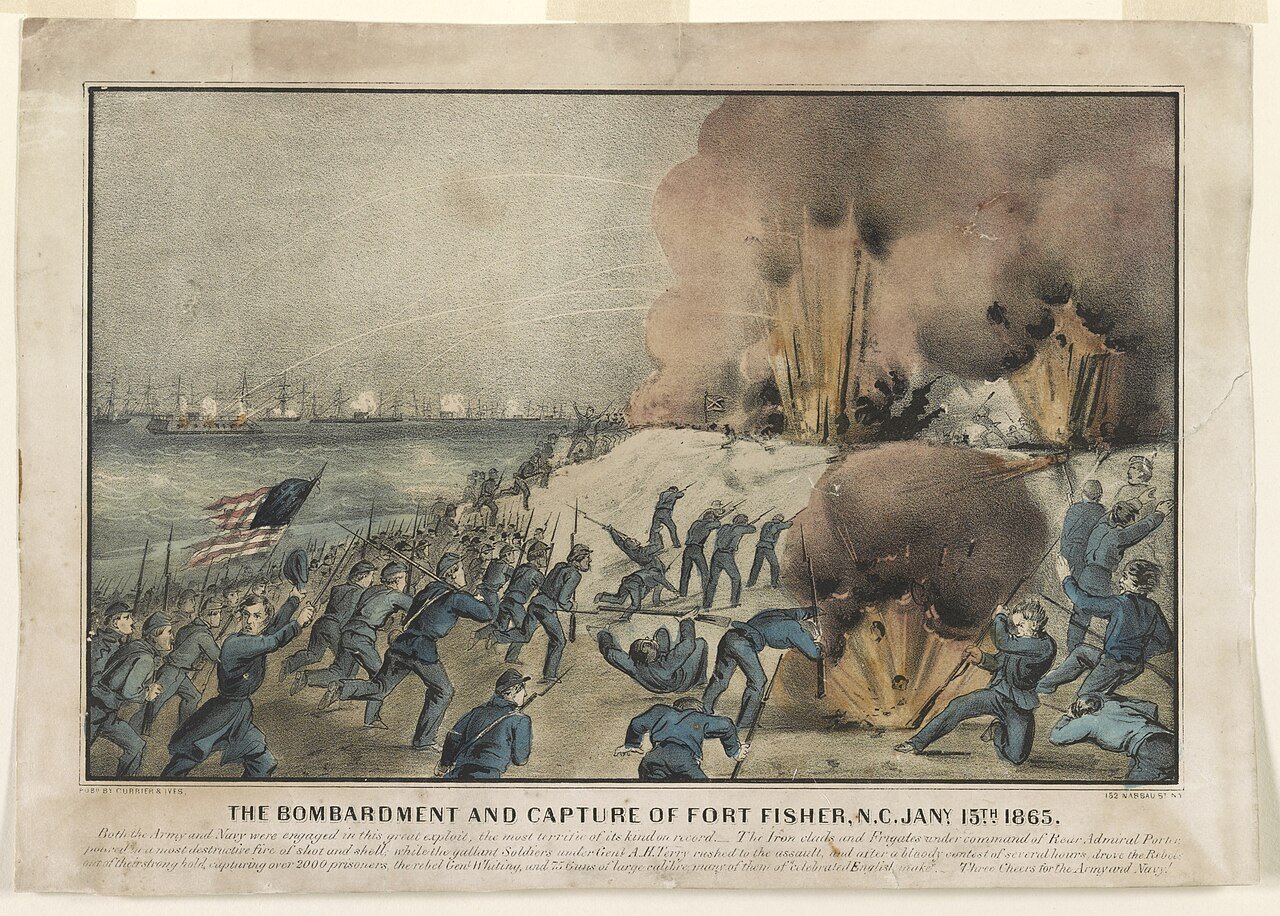
| January 15, 1865 | Fort Fisher fell after a second attack on January 13-15, 1865. Its loss closed Wilmington, described as the last port open to supply the Confederacy. | ncpedia.org |
| March 19-21, 1865 | The Battle of Bentonville, near Bentonville in Johnston County, was the largest Civil War land battle in North Carolina. Gen. Joseph E. Johnston had about 21,000 Confederates; Maj. Gen. William T. Sherman had about 60,000 Union soldiers. | ncpedia.org |
| March 21-23, 1865 | The Confederates withdrew from Bentonville on the night of March 21, 1865. Sherman reached Goldsboro on March 23. Losses were 1,527 Union and 2,606 Confederate. | ncpedia.org |
| April 26, 1865 | At the Bennett farm near Durham, Johnston and Sherman reached final surrender terms, 17 days after Lee surrendered at Appomattox. The surrender covered 89,270 soldiers in the Carolinas, Georgia and Florida. | ncpedia.org |
| 1865 | Johnston and Sherman met three times at the home of James and Nancy Bennitt. Sherman's first agreement was turned down by President Andrew Johnson, and the final terms came later. | ncpedia.org |
| 1861-1865 | NCpedia counts 133,905 North Carolinians in state and Confederate forces, and notes this may be too low. Of those, 40,275 (about 30 percent) did not come home. NCpedia also counts 5,035 Black and 3,156 white North Carolinians in the Union army. | ncpedia.org |
| 1921 | The Bennett farmhouse burned, leaving only its stone chimney. A reconstruction was begun in 1960 and dedicated in 1962. | ncpedia.org |
| 2028 | The NC History Center on the Civil War, Emancipation & Reconstruction in Fayetteville, a state museum on the whole state's story, lists its opening as 2028. It is not open yet. | nccivilwarcenter.org |
1861: Leaving The Union
North Carolina did not leave the Union right away. It acted after Fort Sumter was bombarded on April 12, 1861, and Lincoln called for troops on April 15. A convention met in Raleigh on May 20, 1861, and passed the secession ordinance without a single no vote. No one asked the voters. (source)
The ordinance was signed the next day, May 21, 1861, and President Jefferson Davis proclaimed North Carolina a Confederate state. (source)
1862: Roanoke Island and The Coast
In early 1862, Union troops under Ambrose Burnside took Roanoke Island on February 7 and 8. It was called the key to the northeast sounds of North Carolina. Taking it opened Albemarle Sound to the Union, and the next target was New Bern. (source)
Many enslaved people on the island sought freedom after the battle. They formed a freedmen's colony that grew to more than 3,500 people. (source)
Winter 1865: The Fall of Fort Fisher
Fort Fisher kept Wilmington open to ships carrying supplies. By 1865 that was the last supply line still open to Robert E. Lee's army. After a first Union bombardment on December 24-25, 1864, a larger attack on January 13-15, 1865, took the fort. (source)
The loss of Fort Fisher closed the port. Historians at the state historic site say it helped seal the Confederacy's fate. (source)
Spring 1865: Bentonville and The Surrender
Joseph Johnston tried to stop William T. Sherman's army at Bentonville on March 19-21, 1865. His men broke the Union left at first, but fresh troops held. The Confederates withdrew the night of March 21, and Sherman reached Goldsboro two days later. (source)
A few weeks later Johnston and Sherman met at the Bennett farm near Durham. Final terms were reached on April 26, 1865, and the surrender covered 89,270 soldiers across the Carolinas, Georgia and Florida. (source)
The Cost, and How It Is Remembered
NCpedia counts 19,673 battle deaths and 20,602 deaths from disease among North Carolina's Confederate soldiers. Most fighting in the state took place in the east, while the western mountains saw mostly guerrilla violence. (source)
Today the state runs historic sites at Fort Fisher, Bentonville and Bennett Place. A new state museum in Fayetteville, the NC History Center on the Civil War, Emancipation & Reconstruction, lists 2028 as its opening. (source)
Where to Visit
- Fort Fisher State Historic Site: 1610 Ft. Fisher Blvd. South, Kure Beach. Tuesday through Saturday, 9 a.m. to 5 p.m.; closed Sunday, Monday and state holidays. Admission is free. Phone 910-251-7351.
- Bentonville Battlefield State Historic Site: 5466 Harper House Rd, Four Oaks. Tuesday through Saturday, 9 a.m. to 5 p.m.; closed Sunday, Monday and state holidays. Admission is free; guided tour fees apply. Phone 910-594-0789.
- Bennett Place State Historic Site: 4409 Bennett Memorial Rd., Durham. Tuesday through Saturday, 9 a.m. to 5 p.m. Free to enter; guided tours are at 9:45 a.m., 11:00 a.m. and 1:00 p.m. (youth $1, adults $4, seniors and military $3). Reconstructed farmhouse, kitchen and smokehouse.
- Fort Raleigh National Historic Site (Roanoke Island): NPS site on Roanoke Island; its history pages cover the 1862 battle and the freedmen's colony.
- NC History Center on the Civil War, Emancipation & Reconstruction: Planned state museum at 824 Branson Street, Fayetteville. Not open yet; the center lists opening in 2028.
On this site: Fort Fisher State Historic Site, Historic Sites.
Still Unconfirmed
- Union strength at Roanoke Island varies by source (about 10,000 per the state encyclopedia, about 13,000 per the National Park Service), and Confederate dead are given as 23 or 22.
- The first two Johnston-Sherman meetings at Bennett Place are not dated on the pages we read; only April 26, 1865 is.
- The state history center on the Civil War, emancipation and Reconstruction in Fayetteville is under construction, its name has changed between sources and its opening date could move.
- The strength of the Union landing force at Fort Fisher was not on the page we read, so none is stated. The state encyclopedia notes its count of North Carolinians who served may be too low, because the rolls are incomplete.
Frequently Asked Questions
When did North Carolina secede?
A convention in Raleigh met on May 20, 1861, and unanimously passed the secession ordinance. It was signed on May 21, 1861. There was no popular vote.
When did Fort Fisher fall?
January 15, 1865, after a Union attack by sea and land. It had guarded Wilmington, the last port open to supply the Confederacy.
What was the Battle of Bentonville?
A three-day fight on March 19-21, 1865, in Johnston County. It was the largest Civil War land battle in North Carolina, with about 21,000 Confederates against about 60,000 Union soldiers.
Where did Johnston surrender to Sherman?
At the Bennett farm near Durham. Final terms were reached on April 26, 1865, covering 89,270 soldiers in the Carolinas, Georgia and Florida.
What happened at Roanoke Island in 1862?
Union troops under Ambrose Burnside took the island on February 7-8, 1862. 2,488 Confederates surrendered, and the island later became home to a freedmen's colony of more than 3,500 people.
More North Carolina History
- History Hub
- Timeline
- Historic Sites
- Legends Trail
- Appalachian Music
- Black History
- Lighthouses
- Revolutionary War
- Textiles and Tobacco
- Wright Brothers and Aviation
Sources
- NCpedia: Secession Movement
- NCpedia: Civil War (Introduction)
- NCpedia: Roanoke Island, Battle Of
- NPS: The Battle of Roanoke Island (Fort Raleigh)
- NCpedia: Fort Fisher
- NC Historic Sites: Fort Fisher State Historic Site
- NCpedia: Bentonville, Battle Of
- NC Historic Sites: Bentonville Battlefield State Historic Site
- NCpedia: Bennett Place
- NC Historic Sites: Bennett Place State Historic Site
- NC History Center on the Civil War, Emancipation & Reconstruction: About the Center
- Wikimedia Commons: Currier & Ives print, Library of Congress copy (rights statement)
Read on October 27, 2026. Secondary sources are labelled in their titles. How we check: editorial standards; spot a mistake? tell us.
Cite this page: It's North Carolina, “The Civil War in North Carolina”, itsnorthcarolina.com/history/civil-war/ (updated ). By the It's North Carolina editorial team. Free to quote with attribution and a link to this page; data and tables are licensed CC BY 4.0.