Home › North Carolina History › Wright Brothers and Aviation
On December 17, 1903, Orville Wright flew the first powered, controlled airplane flight at Kill Devil Hills: 120 feet in 12 seconds, starting at 10:35 a.m. Wilbur flew the longest of the day's four flights, 852 feet in 59 seconds.
- Sep 12, 1900Wilbur reaches Kitty Hawk
- Dec 17, 1903Four powered flights
- 120 ftFlight 1, in 12 seconds
- 852 ftFlight 4, in 59 seconds
- Short Version
- At a Glance
- Why Kitty Hawk
- 1900 to 1902: learning to glide
- December 17, 1903
- After Kitty Hawk, and remembering it
- Visit
- FAQ
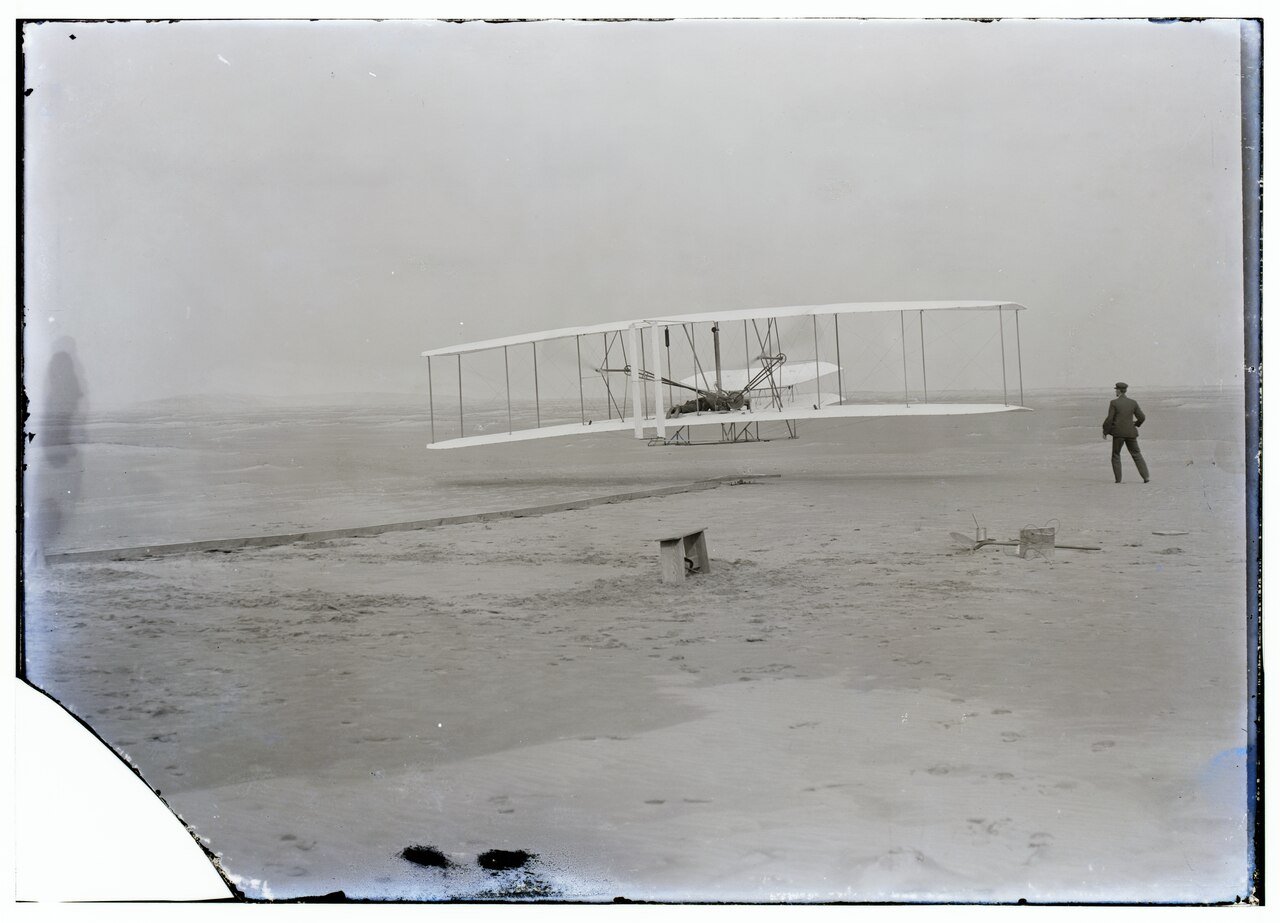
The Short Version
The brothers chose the Outer Banks for its steady winds after writing to the U.S. Weather Bureau. They tested gliders in 1900, 1901 and 1902, and the 1902 glider was the first aircraft with three-axis control. Four powered flights on December 17, 1903 followed, and a gust of wind damaged the Flyer after the last one.
At a Glance
| Date | What happened | Source |
|---|---|---|
| 1867 and 1871 | Wilbur Wright was born in 1867 near Millville, Indiana. Orville Wright was born in 1871 in Dayton, Ohio. The family treated Dayton as home. | nps.gov |
| September 12, 1900 | Wilbur arrived at Kitty Hawk. Orville joined him about two weeks later. The brothers picked the Outer Banks after writing to the U.S. Weather Bureau, for its steady winds and sand dunes to cushion landings. | nps.gov |
| October 18, 1900 | Wilbur made an unpowered glide of roughly 300 to 400 feet, lasting up to 15 seconds. The brothers left on October 23, 1900. | nps.gov |
| July 17 to August 16, 1901 | The brothers tested a larger glider at Kill Devil Hills. Their best flight covered 389 feet. | nps.gov |
| August 27, 1902 | The brothers returned with a new glider with a movable rudder, the first aircraft with three-axis control. Wilbur's best glide covered 622 feet in 26 seconds. | nps.gov |
| September 23, 1903 | The brothers left Dayton for Kitty Hawk with their powered airplane, after about four years of experiments. | nps.gov |
| December 17, 1903 | Flight 1: Orville flew at 10:35 a.m. for 12 seconds and 120 feet. The Flyer left a starting rail into a 27-mph wind. | nps.gov |
| December 17, 1903 | Flight 2: Wilbur flew about 175 feet in about 12 seconds. | nps.gov |
| December 17, 1903 | Flight 3: Orville flew about 200 feet in about 15 seconds. | nps.gov |
| December 17, 1903 | Flight 4: Wilbur flew 852 feet in 59 seconds, the longest of the day. | nps.gov |
| December 17, 1903 | John Daniels, from the nearby lifesaving station, took the famous photograph of Orville's takeoff with Wilbur running alongside. | nps.gov |
| December 17, 1903 | After the last flight a gust of wind rolled the Flyer, damaging it beyond easy repair. | nps.gov |
| September 3, 1908 | Orville made the first public flight at Fort Myer, Virginia. | nps.gov |
| May 30, 1912 and January 30, 1948 | Wilbur died on May 30, 1912. Orville died on January 30, 1948. | nps.gov |
Why Kitty Hawk
Wilbur and Orville Wright were self-taught engineers from Dayton, Ohio. They wanted a place with strong, steady wind and soft sand to land on. After writing to the U.S. Weather Bureau, they chose the Outer Banks near Kitty Hawk. (source)
Wilbur reached Kitty Hawk on September 12, 1900, and Orville followed about two weeks later. (source)
1900 to 1902: Learning to Glide
In 1900 the brothers first tested a glider on the Outer Banks. In 1901 they came back with a bigger one and flew as far as 389 feet. Wind-tunnel tests in Dayton then showed that earlier lift tables were largely correct. (source)
In 1902 they flew a new glider with a movable rudder nearly 1,000 times. It was the first aircraft with three-axis control. By then they had made over a thousand glides from Big Kill Devil Hill before trying powered flight. (source)
December 17, 1903
On the morning of December 17, 1903, the brothers made four powered flights. The first, with Orville at the controls at 10:35 a.m., lasted 12 seconds and covered 120 feet. The next two covered about 175 feet in about 12 seconds and about 200 feet in about 15 seconds. The fourth, flown by Wilbur, went 852 feet in 59 seconds. (source)
A 27-mph wind blew into the Flyer. Volunteers from the nearby lifesaving station helped, and one of them, John Daniels, took the famous photograph. After the last flight a gust of wind rolled the Flyer over and damaged it. (source)
After Kitty Hawk, and Remembering It
Orville made the first public flight on September 3, 1908, at Fort Myer, Virginia. Wilbur died on May 30, 1912, and Orville on January 30, 1948. (source)
Wright Brothers National Memorial in Kill Devil Hills marks the spot. Visitors can walk up Big Kill Devil Hill to the monument and walk the flight line where the first flights landed. The First Flight Society, based in Kill Devil Hills, works to keep the Wrights' legacy alive through education and events. (source)
Where to Visit
- Wright Brothers National Memorial: NPS site in Kill Devil Hills (address 1401 National Park Drive, Manteo). Monument on Big Kill Devil Hill, copper busts, a boulder and plaque where the 1903 flyer took off, and the flight line you can walk. Open every day except December 25. Phone 252-473-2111. Check the park's pages for current hours and fees.
- First Flight Society: Non-profit based in Kill Devil Hills that preserves the Wright brothers' legacy with aviation education, events and memberships.
On this site: Wright Brothers National Memorial, Outer Banks, Outer Banks Long Weekend.
Still Unconfirmed
- The National Park Service first-flight page does not name the pilots of flights 2 and 3; they come from its overview article about the brothers.
- Hours and fees for the memorial were not on the page we read, which is dated 2021, so check the park before you go. We did not confirm a visitor center or reconstructed camp buildings.
- The First Flight Society page we read did not give its founding year.
Frequently Asked Questions
When was the Wright brothers' first flight?
On the morning of December 17, 1903, at Kill Devil Hills near Kitty Hawk. The first flight, with Orville at the controls, started at 10:35 a.m.
How long and far were the four flights?
Flight 1: 12 seconds, 120 feet. Flight 2: about 12 seconds, about 175 feet. Flight 3: about 15 seconds, about 200 feet. Flight 4: 59 seconds, 852 feet.
Why did the Wright brothers choose Kitty Hawk?
After writing to the U.S. Weather Bureau, they picked it for its strong, steady winds and sand dunes that cushioned landings.
Who took the famous photo of the first flight?
John Daniels, from the nearby lifesaving station, took the photo of Orville's takeoff with Wilbur running alongside.
Can I visit where the first flight happened?
Yes. Wright Brothers National Memorial in Kill Devil Hills is open every day except December 25. You can walk the flight line and climb Big Kill Devil Hill to the monument.
More North Carolina History
- History Hub
- Timeline
- Historic Sites
- Legends Trail
- Appalachian Music
- Black History
- Civil War
- Lighthouses
- Revolutionary War
- Textiles and Tobacco
Sources
- NPS: Wright Brothers
- NPS: 1903 – The First Flight, Wright Brothers National Memorial
- NPS: Four Powered Flights
- NPS: Wright Brothers National Memorial home page
- NPS: Wright Brothers National Memorial, Basic Information
- NPS: Wright Brothers National Memorial, History & Culture
- First Flight Society
- Wikimedia Commons file page for the Library of Congress photo (rights statement)
Read on October 27, 2026. Secondary sources are labelled in their titles. How we check: editorial standards; spot a mistake? tell us.
Cite this page: It's North Carolina, “The Wright Brothers and The First Flight”, itsnorthcarolina.com/history/wright-brothers-and-aviation/ (updated ). By the It's North Carolina editorial team. Free to quote with attribution and a link to this page; data and tables are licensed CC BY 4.0.